
Insurance Agency Valuation: What Makes Your Business Worth More

Valuing your agency is not just an exit exercise. It is a way to ask whether your agency's earnings, customer relationships, team, and records would still hold up if someone other than you had to understand and run the business.
That question matters even if you have no plans to sell. A business with durable earnings, a well-kept book, clear ownership, and dependable records is easier to manage, finance, transfer, or grow.
There is no universal formula that can tell you what your agency is worth. A credible valuation depends on what is being valued, why it is being valued, the financial evidence, the market, and the risks a buyer or appraiser sees.
This guide explains the main ideas at an owner-friendly level, then turns them into an operating checklist you can use without pretending to calculate a sale price.
What an insurance agency valuation actually measures
A valuation estimates the value of a defined business interest at a particular time and for a particular purpose. That’s a mouthful, so let’s break it down:
The whole agency is not always the same asset as its book of business. A book may include customer relationships, policies, and renewal economics. The operating business can also include employees, carrier relationships, processes, technology, brand, contracts, liabilities, working capital needs, and the ability to produce future cash flow without the current owner doing every important job.
Start by naming the subject. Are you discussing the operating company, a block of policies, a minority interest, or selected assets? Is the purpose a sale, succession plan, financing conversation, tax matter, or internal planning exercise?
This is why a casual revenue multiple can create false confidence. If someone quotes 1-2x or 6x revenue, ask what was sold, which earnings measure and deal terms sit behind the figure, and whether it came from a closed transaction. Neither number values your agency by itself.
How insurance agency valuation methods work
Professional valuation standards recognize several approaches. For an established agency, the two most intuitive are an income approach and a market approach. A qualified valuation professional may use one or more methods and reconcile the results based on the assignment and available evidence. To see how the methods differ, compare two hypothetical Medicare agencies with the same application volume but different operating structures. The figures are invented, not industry benchmarks.
The income approach looks at future economic benefit
An income approach connects value to the future income or cash flow the business is expected to produce, adjusted for timing and risk. Historical financial statements help establish patterns, but the past is not automatically the forecast.
An owner should expect questions about what revenue is recurring, what costs are required to sustain it, whether recent growth is repeatable, and which expenses or income items are unusual. "Normalized earnings" means financial results adjusted to better represent ongoing operations. The exact adjustments require judgment and support.
Do not assume every owner salary, family payroll item, or discretionary expense simply gets added back. A buyer may need to replace work the owner performs, and that replacement has a real cost. Normalization should make the economics more representative, not make the number as large as possible.
Consider the first agency. During Medicare's annual enrollment period (AEP), its agents submit 25,000 applications, and 20,000 policies become effective. Agents make data-entry mistakes on 800 applications, and every correction goes to the owner. The owner also holds the upline relationship and is the sole contact for carrier appointments and escalations.
The agency reports $200,000 in operating profit after paying the owner a $300,000 salary. If a buyer simply adds back that salary, earnings appear to be $500,000. But a buyer still needs someone to do that work. Assume the agency would need an enrollment-operations lead at $180,000 a year and a carrier/upline relationship lead at $150,000. After those replacement salaries, illustrative earnings are $170,000 before benefits, transition costs, or other adjustments.
An income-based analysis would test whether that level of earnings can continue, rather than annualizing the best AEP. The agency could also reduce the dependency: log each correction, route routine fixes to an operations queue, define which exceptions need escalation, and have the new leads run the process and partner contacts while the owner is still there.
The market approach compares relevant transactions
A market approach uses evidence from sales of comparable businesses or interests. Multiples can express those comparisons relative to revenue, seller's discretionary earnings, or EBITDA.
The hard part is comparability. Agency size, line of business, margins, growth, retention, carrier mix, customer concentration, geography, owner involvement, and transaction terms can all matter. A multiple drawn from a small local book may not fit a larger operating company. An advertised asking price is not the same as a closed transaction. A headline multiple may also describe a different earnings measure than yours.
Treat insurance agency valuation multiples as evidence that needs context. Ask what population produced the number, when the transactions occurred, what financial measure was used, and how your agency differs.
Now compare a second hypothetical Medicare agency. It also submits 25,000 AEP applications, has 20,000 effective policies, and collects $10 million in commission revenue. Its agents generate 650 data corrections, but a staffed queue handles routine fixes and an operations manager reviews unresolved cases. Two managers maintain upline and carrier contacts, and agents are appointed with alternatives in the counties where the agency sells. Suppose this agency closes at $4.8 million on $1.2 million of normalized annual earnings, with the seller staying for a one-year transition. That is a 4x earnings multiple for this invented transaction, not a market benchmark. Applying 4x to the first agency without accounting for its $170,000 illustrative earnings, owner-controlled corrections, appointment gaps, and different transition terms would not compare like with like.
Five operating questions that shape agency value
Owners cannot control the market multiple available years from now. They can improve the quality of the business and the evidence behind it. The following framework is not a professional valuation method. It is an operating review built for life, health, Medicare, and ACA agencies. The examples are hypothetical and show what an owner could investigate, not what any agency is worth.
1. How durable are the earnings?
A single strong season does not tell the full story. A reviewer will want to understand where revenue comes from, what it costs to produce, how results change by season, and whether performance is repeatable.
Consider the same Medicare agency across two AEPs. In the earlier season, 20,000 applications produced 16,000 effective policies and $8 million in collected commissions. Leads cost $100 per submitted application, or $2 million total. After $2.4 million in agent pay, $2 million in other operating costs, and the owner's $300,000 salary, operating profit was $1.3 million. In the recent season, applications rose to 25,000 and effective policies to 20,000, bringing collected commissions to $10 million. But lead cost rose to $180 per application, or $4.5 million total. Agent pay was $3 million; the other costs and owner salary stayed the same. Operating profit fell to $200,000. At 25,000 submissions, another $8 in lead cost per application would erase that remaining profit if the other assumptions held. More applications and more revenue did not make earnings more durable because acquisition cost grew faster. All figures are hypothetical.
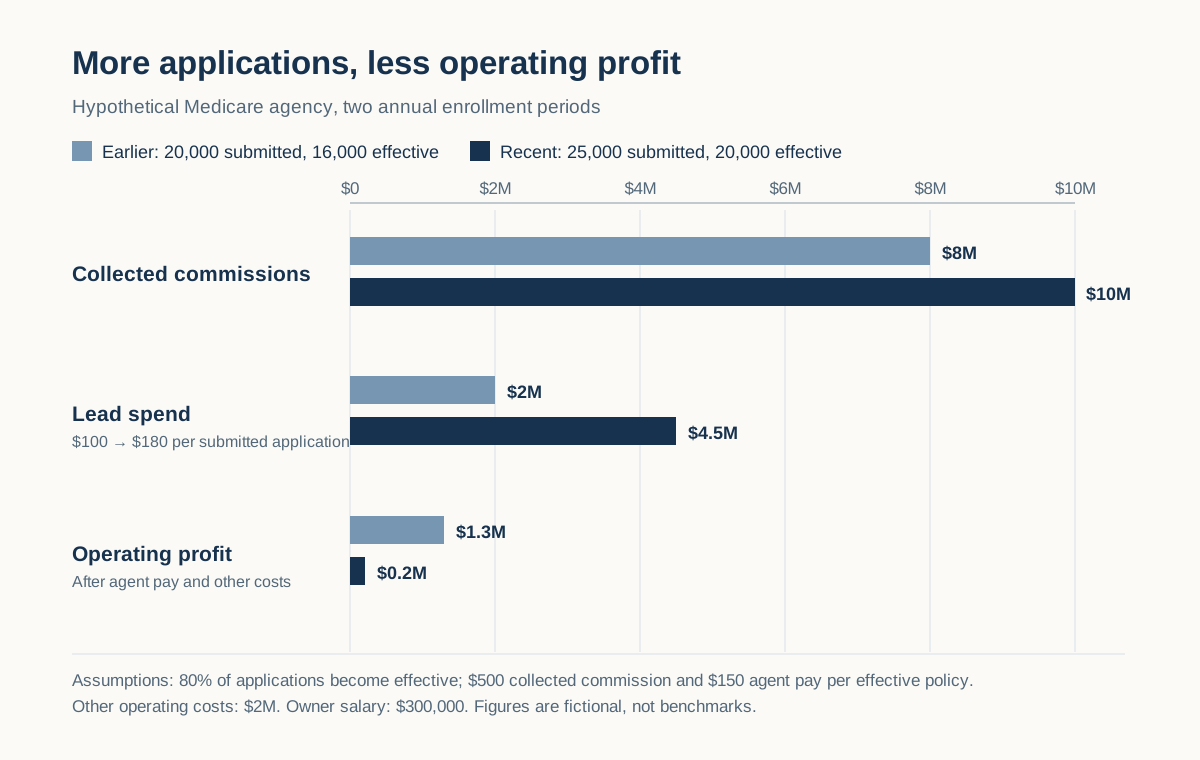
Image: Hypothetical Medicare AEP comparison, applications rise from 20,000 to 25,000, while higher lead costs cut operating profit from $1.3 million to $200,000.
Evidence to maintain: monthly revenue and expense statements using consistent categories; production and conversion trends by product and source; staffing and marketing costs tied to the same periods; written explanations for material one-time items.
Operating action: compare commission revenue, lead spend, submitted applications, effective policies, and early cancellations by campaign and season. Set a trigger for pausing or renegotiating a lead source when its economics deteriorate. Reconcile the operating and financial reports before using the trend in a valuation discussion.
2. How well does the book retain?
New production gets attention, but future economics depend on how much valuable business remains. Retention or persistency should be defined carefully for the products you sell. Policy count, premium, members, and commission revenue can produce different views, and early cancellations may matter differently from later attrition.
Take the 20,000 policies that became effective in the recent AEP. The CRM lists 19,200 as active after 90 days, but carrier statements show expected payments on only 18,700. The 500-policy gap could reflect delayed statements, stale CRM statuses, or early cancellations. Operations reconciles the policies by ID before the owner treats the CRM number as a retention rate.
Evidence to maintain: a documented retention definition; cohort views by effective period, product, carrier, source, and producer where appropriate; cancellation reasons that are specific enough to act on; reconciliation between policy status and revenue records.
Operating action: assign an owner to the 500-policy gap. Separate policies that never became effective from early cancellations and delayed payments, then review the next cohort using the same definitions.
3. Where is the business concentrated?
Concentration can make good results more fragile. An agency may rely heavily on one carrier, product, lead source, producer, vendor, state, or season. The issue is not that concentration is always bad. It is whether the owner understands the exposure and has a credible response if that dependency changes.
For example, a Medicare agency has 8,000 active policies with one carrier. Of those, 3,000 are in two counties that the carrier will leave next plan year after a service-area reduction. The agency and most of its agents have not completed appointments with other carriers in those counties. The owner cannot assume the affected members will simply move to another plan or that the renewal revenue will remain. A concrete response is to identify affected policies by plan and county, confirm which alternatives are available, complete agency and agent appointments and training, and prepare compliant member support before the change takes effect. That is a much stronger answer to a buyer than saying the agency can diversify later.
Evidence to maintain: revenue and policy distribution by the categories that matter to your business; trend lines rather than a single snapshot; contract or appointment dependencies; a record of contingency plans and tested alternatives.
Operating action: keep a county-level list of affected policies, available plan options, and which agents have completed the required appointments and training. Assign one manager to keep that list current before AEP.
4. How dependent is delivery on the owner?
An owner can be the agency's greatest strength and still create transfer risk if every exception, relationship, and approval runs through them. The same problem appears when a star producer or operations lead holds the playbook in their head. A buyer can take over a business whose workflows, customer context, and performance survive changes in personnel. If results depend on particular people agreeing to join the buyer, the deal may look more like an acqui-hire than the purchase of a transferable operating business. That can narrow what the buyer is paying for; it is not a fixed pricing rule.
In the 25,000-application agency, 300 of the 800 data corrections arrive in the final two weeks of AEP and go straight to the owner's inbox. When the owner is away, nobody can see which cases were fixed, which need resubmission, or which carrier contact can resolve an exception. The agency may have produced a large book, but the correction process and partner access still belong to one person.
Evidence to maintain: clear role ownership; approval thresholds; current process documentation for critical workflows; delegation records; performance reporting that does not require the owner to reconstruct the story.
Operating action: move the 800 corrections into a shared queue with error codes, owners, due dates, and escalation rules. Have the operations and carrier leads run the queue and partner calls for two weeks while the owner observes rather than resolves cases.
5. Can another person verify the records?
Clean records do more than make diligence easier. They let the owner run the agency with confidence. Customer, policy, call, lead, producer, compliance, and financial records should connect well enough that another qualified person can follow an important result back to its source.
This does not require putting every function in one product. Specialized quoting and enrollment systems can remain specialized. The question is whether handoffs are defined, identifiers stay consistent, exceptions are visible, and reports agree with the records used to do the work.
For example, finance reports $10 million in commissions from the recent AEP cohort. The CRM holds 25,000 submitted applications, while the carrier files show 20,000 effective policies. If 400 carrier records cannot be matched to an application ID, another person cannot reproduce the $10 million figure without manual explanations. The agency should reconcile those IDs and retain the exceptions, not just hand over the summary total.
Evidence to maintain: named systems of record for critical fields; consistent identifiers; access and change controls; documented reconciliations; retained source records; definitions for the metrics leadership uses.
Operating action: start with the $10 million commission report. Match carrier payments to effective policies and application IDs, investigate the 400 unmatched records, and record who approves each resolution.
Onyx's insurance management system guide explains how a shared operating foundation can connect the record, the work, and owner control. The technology growth scorecard can help you assess whether the current stack supports reliable growth. Neither replaces a professional valuation.
A value-driver checklist for this quarter
You do not need an active transaction to make the agency more understandable. Use this six-step review on one value driver at a time:
Name the driver. Choose durable earnings, retention, concentration, owner independence, or record quality.
Define the measure. Write down exactly what is included, excluded, and when it is measured.
Name the source. Identify the authoritative system or record behind the number.
Assign an owner. Make one person accountable for the definition, data quality, and review cadence.
Show the trend. Keep comparable monthly or quarterly history and explain material breaks.
Take one operating action. Fix a handoff, reduce a dependency, document a decision, or reconcile a disputed number.
For example, imagine an agency that reports strong renewal revenue but cannot reproduce retention by cohort. The valuable first step is not applying a higher multiple. It is defining the retention measure, reconciling policy statuses to revenue, and assigning responsibility for exceptions. The result is better operating evidence whether the owner holds the business for ten years or explores a transaction later. This example is hypothetical and does not estimate value.
Build a business that is easier to understand and trust
Useful valuation work begins before anyone asks for a price. Durable earnings, a retained book, managed concentration, a capable team, and verifiable records make the agency easier to run and give professionals better evidence if a valuation becomes necessary.
Avoid chasing a single rule of thumb. Decide what is being valued, keep the financial definitions honest, and improve one documented value driver at a time.
Onyx helps telephonic life, health, Medicare, and ACA agencies connect CRM, calls, lead routing, policy context, compliance, and reporting on one operating foundation. If you want to see how your agency's day-to-day records and workflows can become easier to manage and verify, book a demo.