What "AI-Powered" Should Mean for Insurance
There is a lot of "AI-powered" software in insurance right now, and a lot of it feels like the same pitch with different branding.
Add a chatbot. Add a note summary. Add a score. Add a copilot button. Add another tool. Hope your team uses it.
We think that is backwards.
If you run an agency or carrier operation in a regulated market, the question is not whether AI is exciting. The question is whether it helps your business work better on real days, with real agents, real members, real policies, and real compliance requirements on the line.
That starts with a simple truth: organizations do not adopt AI in the same way, and they do not all want software to work the same way either.
The right AI depends on how your team wants to work
Most of the industry puts agencies on a single spectrum from "getting started with AI" to "advanced AI team." That misses something important. A 500-seat call center with a sharp ops team might configure every routing rule, scoring threshold, and automation trigger on the platform, and never once talk to an AI. Under the single-spectrum model, they look like beginners. They are not. They just want AI to be invisible.
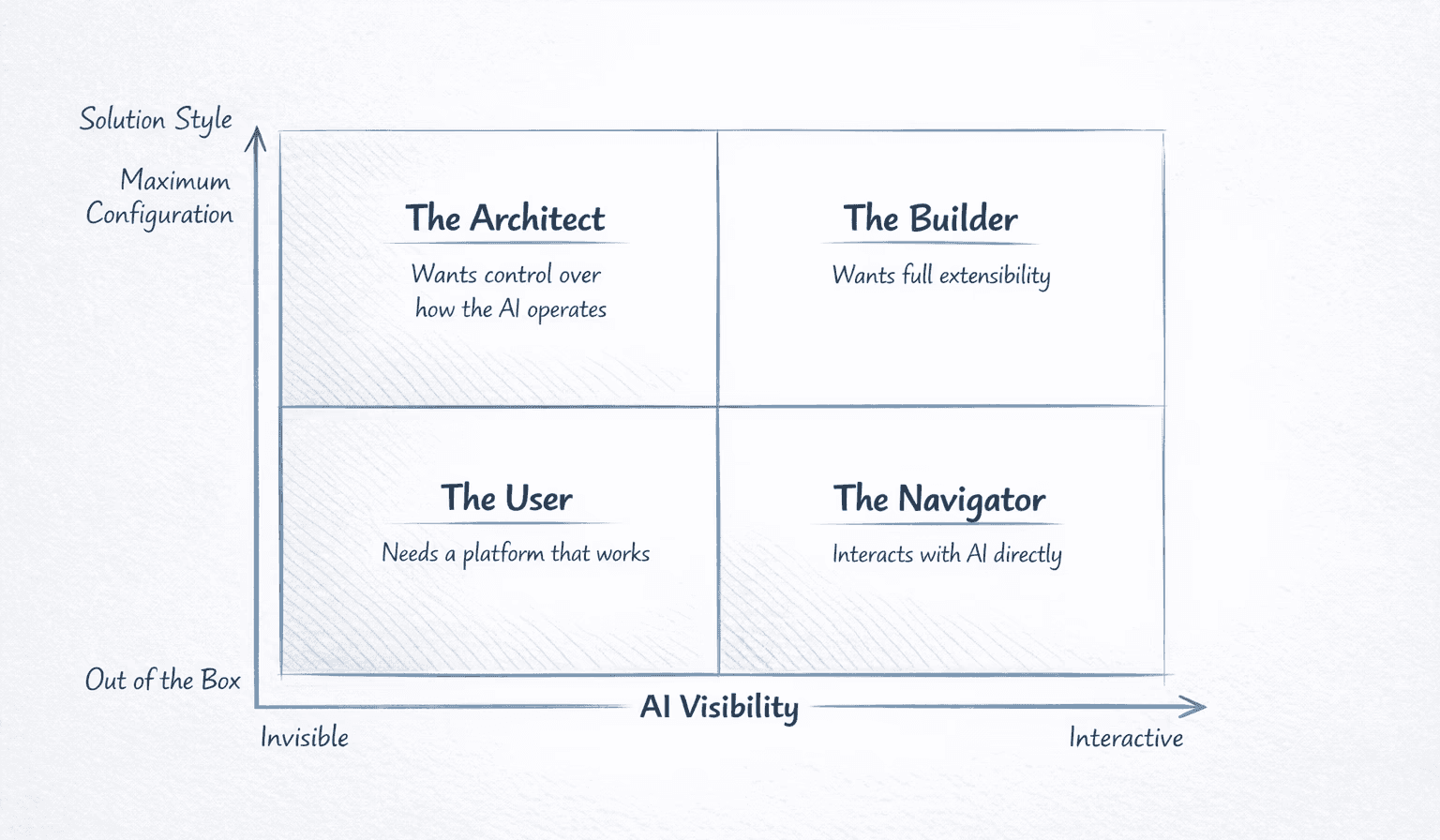
We think about AI in insurance and agency operations along two independent dimensions.
AI visibility: is AI invisible or fully interactive? On one end, AI works behind the scenes. It scores calls, ranks lead sources, flags compliance issues. Your team never interacts with it. On the other end, AI is something your team talks to. They ask questions, trigger actions, get answers.
Solution usage style: does your team take the defaults, or configure the system? Some teams want strong out-of-the-box experiences. Others want to design the rules, set the thresholds, and build workflows that match how their operation actually runs.
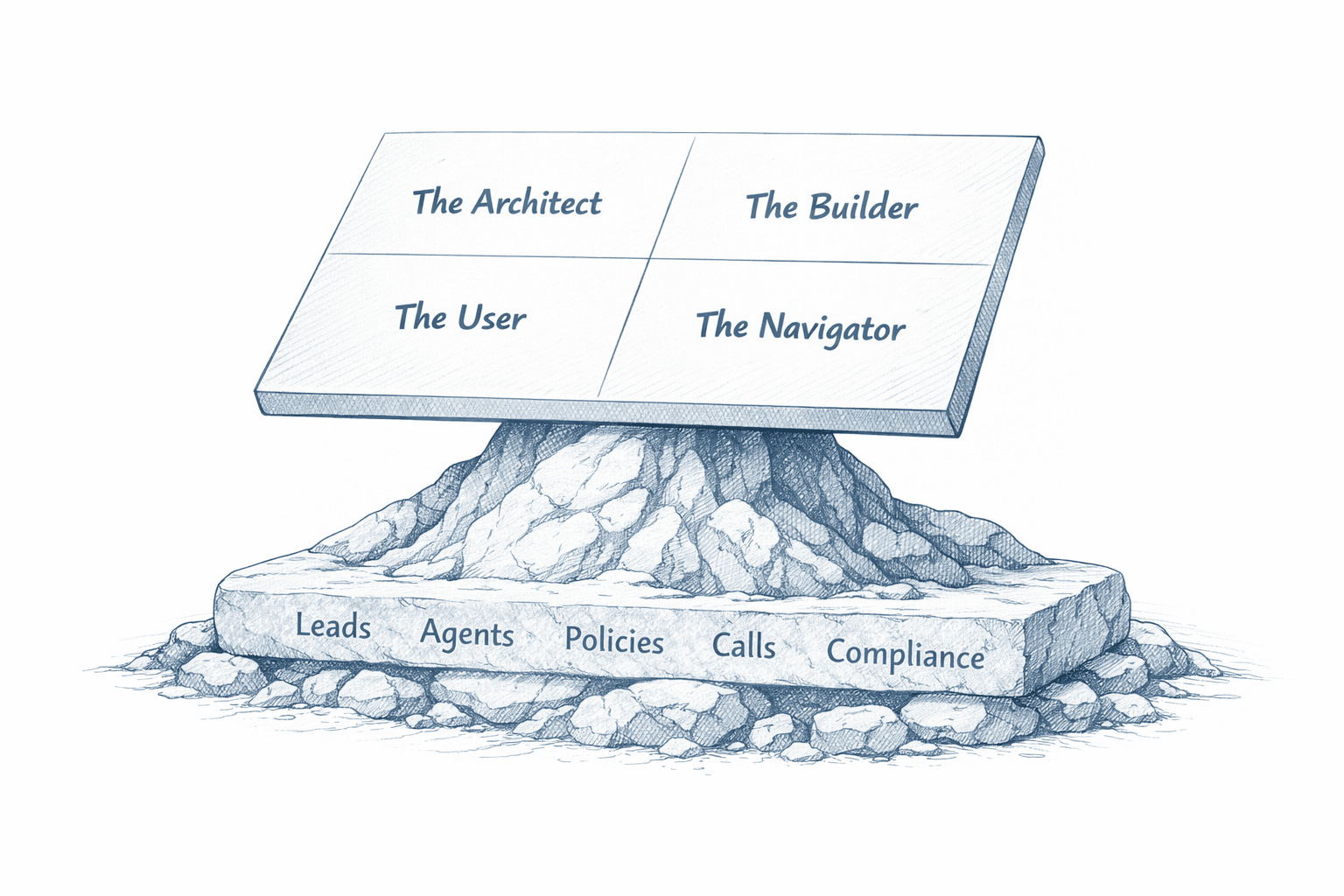
Those two dimensions create four identities.
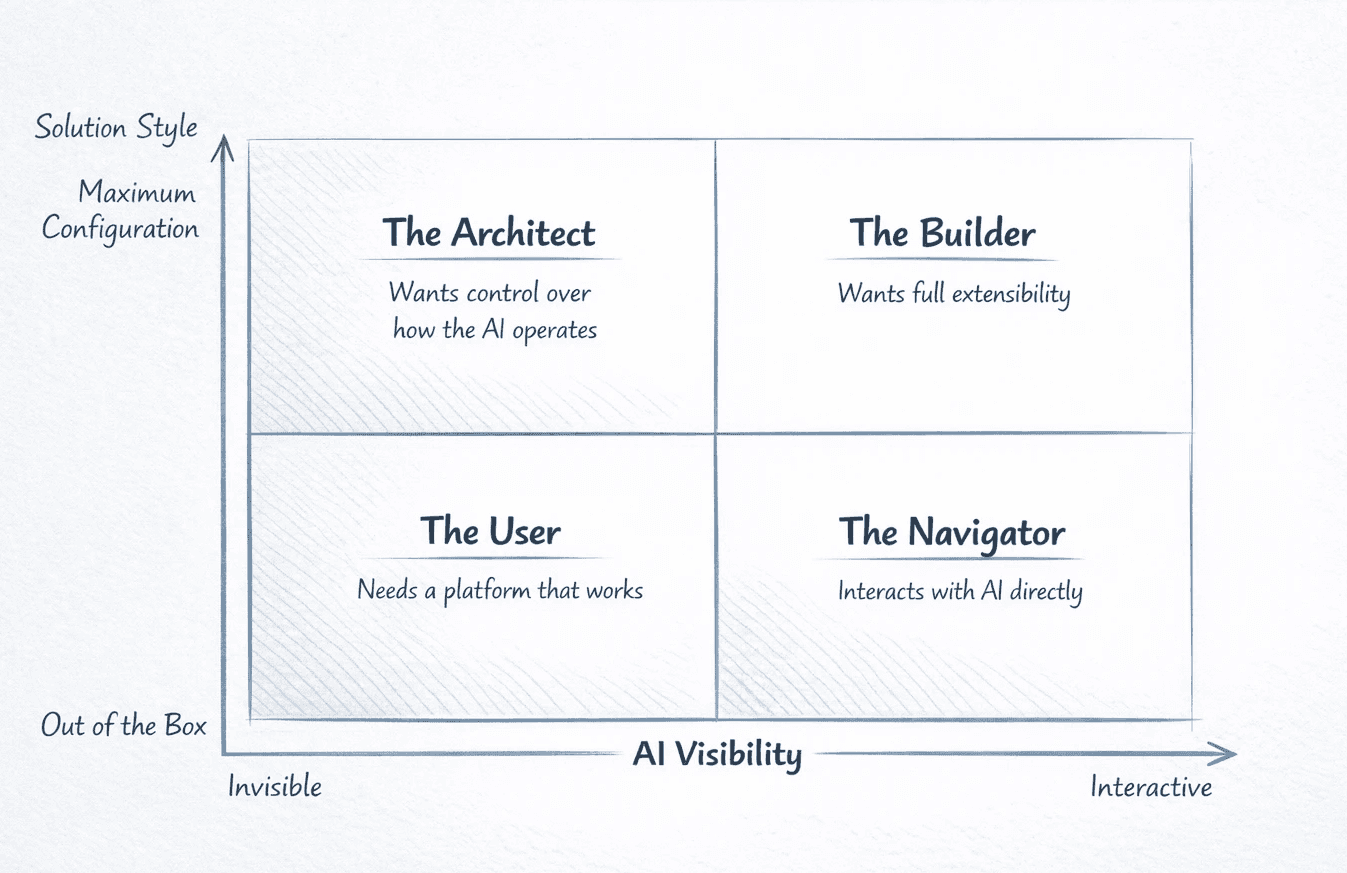
The User does not think about AI. Compliance scoring runs automatically. Lead sources get ranked. Coaching flags show up. No settings page, just results. This is where most people inside an agency are: the agent making calls, the manager reviewing performance, the coordinator scheduling follow-ups. They do not need a relationship with AI. They need a platform that works.
The Navigator interacts with AI directly, but through served experiences. They ask the assistant about yesterday's call volume. They pull a report without building one. They get an answer from operational data without filing a ticket. The AI is visible and useful, but the Navigator is not configuring anything.
The Architect wants control over how AI operates. They design the scoring criteria, the routing logic, the coaching thresholds, the automation rules. Then they walk away and let the system execute. Platform power users, not AI power users.
The Builder wants full extensibility. They connect Claude, Manus, or custom tools to the platform via MCP and SDK. They build workflows that span multiple systems.
What matters is that these are not fixed labels.
Over time, nearly every agency will adopt AI in some form. What changes is how people want to use it. Some teams will start as Users and grow into Navigators or Architects. A smaller group will become Builders. And as the platform evolves, what requires a Builder today becomes accessible to a User tomorrow.
That pattern is not unique to AI. In enterprise software, there have always been teams that want strong defaults and teams that want more control. We expect the AI axis to move over time. We do not expect that core difference in usage style to disappear.
Our job is to be there for all styles today and support their journeys over the next few months and years.
AI only works if it sits on top of a real operating system
This is where a lot of AI products break down.
They can generate something interesting, but they are disconnected from the real operating system of the business. They do not understand the lead, the policy, the agent, the compliance workflow, or what happened on the last call. They are a layer, or a point solution, not a system.
That is not enough for insurance.
If AI is going to improve outcomes in a compliant and durable way, it has to sit on top of a platform that already understands the business. Every lead. Every policy. Every agent. Every call. Every compliance event. Every handoff.
That is how AI stops being a demo feature and starts becoming operational leverage.
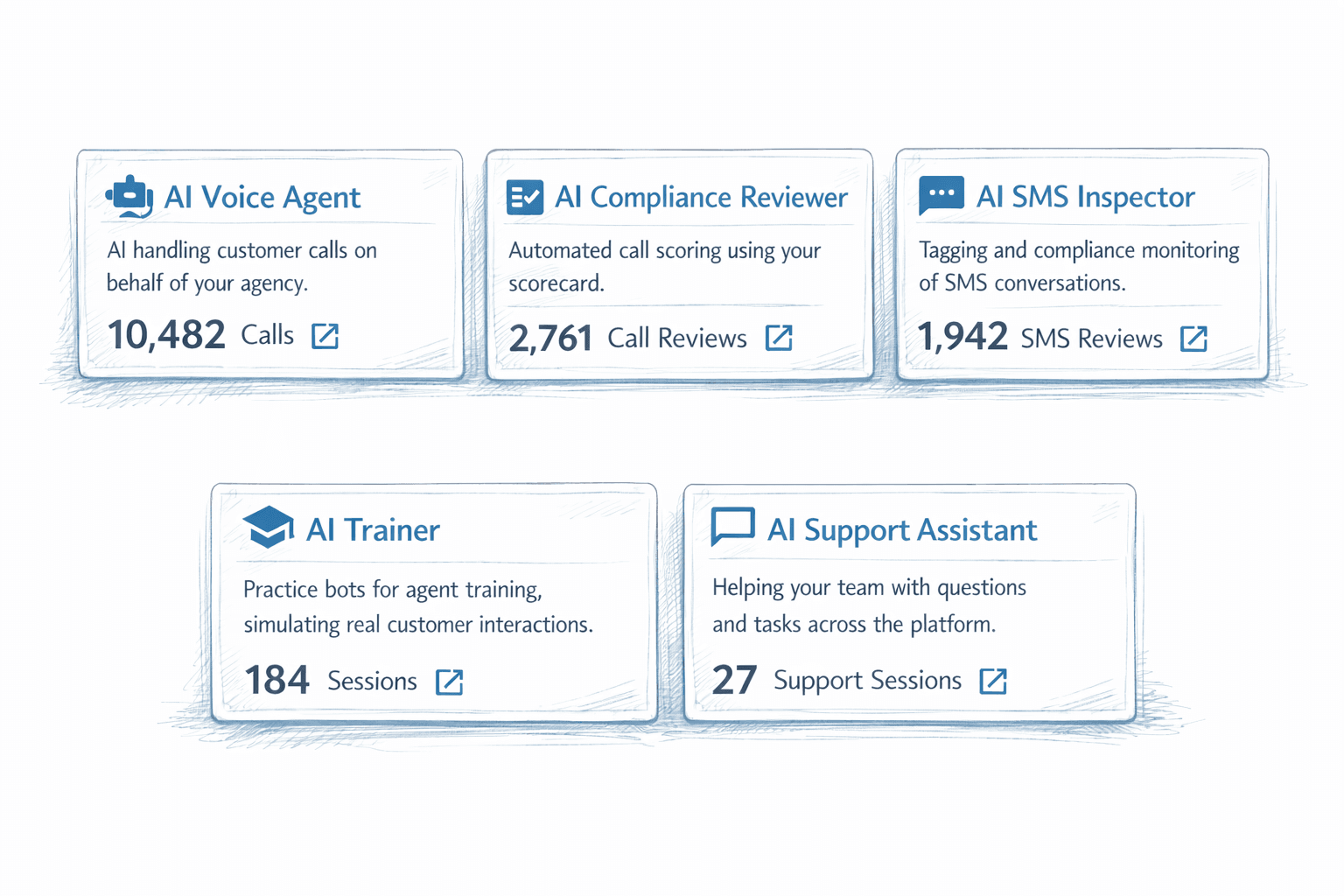
A voice bot can only route well if it understands context and downstream ownership. A compliance reviewer is only useful if its output ties back to real workflows managers can act on. An SMS reviewer only matters if it is connected to the actual conversation history, permissions, and recordkeeping underneath it. An assistant only helps if it can answer questions from the real system your team runs on.
This is also why we think agencies and carriers should not have to choose between safe and useful. If the platform underneath is strong, you can have both.
AI should make the business better, not just make the product sound modern
We are building AI across that full spectrum. But the goal is not to shove AI into every corner of the product and hope customers adapt.
The goal is to help agencies and carriers get stronger in ways that actually matter. Better compliance. Faster decisions. Better coaching. Better use of agent time. Better follow-up. Better transfer logic. Better visibility.
Some customers want one strong default. Some want configurable systems. Some want to build with us. We are here for all of them, and for the teams that will move between them over time.
That is what "AI-powered" should mean: not more noise, not more disconnected features, but better business outcomes built on top of a platform that already knows how your operation works.